



Welcome to the first edition of the Amiral newsletter.
We started Amiral to back founders who see what others miss and build where others won’t.
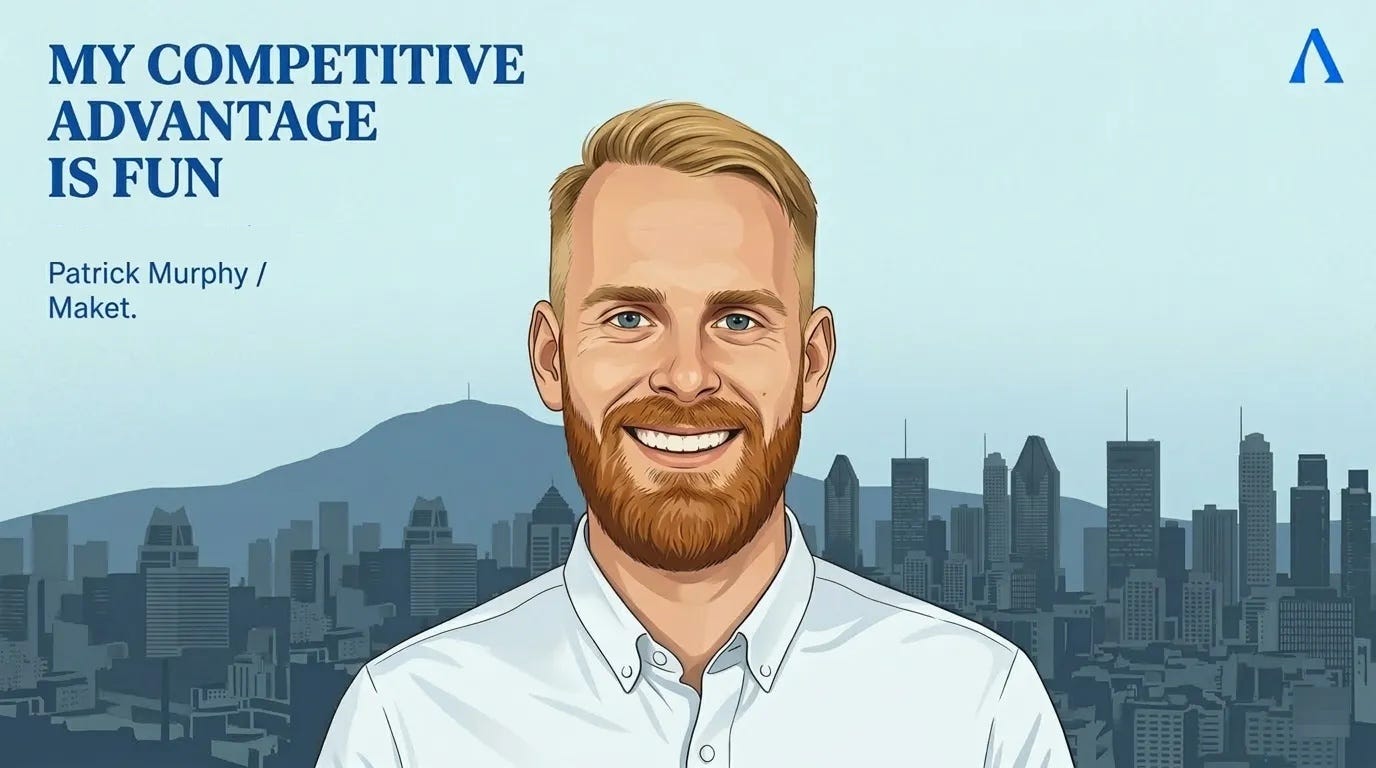
For our first issue, we’re starting with Patrick Murphy, founder of Maket. He’s making residential architecture accessible to anyone, no CAD, no $10K design retainer, just describe what you want. It’s a massive opportunity hiding inside one of the largest, most fragmented, and least digitized industries in the world.
Patrick is exactly the kind of founder we built Amiral for.
You’re receiving this because you’re part of the Amiral network. Not relevant? Unsubscribe here.
A warehouse on the outskirts of Montreal was the not the kind of place a father takes his 14-year old son.
Patrick Murphy sat in the passenger seat, watching the city’s polished neighbourhood dissolve into industrial grey, trying to keep his nerve. He asked for this trip himself, explained his idea with enough conviction that his father had listened, driven across town, and walked through a an industrial factory that looked like it was a hideout for criminal activity. Inside, among bolts of fabric and racks of blank shirts, Patrick picked out his production run while his father paid for it. The logo was already finished, as Patrick had built it himself, on Illustrator.
He called the brand Ambassador Apparel, because they would be ambassadors for Christ. Even at 14 he understood that a name should carry meaning and weight. He took the shirts to school and sold them in limited drops, manufacturing scarcity before he had a word for the strategy. He never lost money, but never really made any either. Each run broke more or less even.
This was Patrick’s first entrepreneurial experience, and although it was not a success story by any conventional measure, it proved something else. That he could originate an idea, build it into something physical, find the people who wanted it, and moved it from his hand to theirs.
Childhood
Otterburn Park sits on the South Shore of Montreal, a quiet city beside the hiking trails and rocky face of Mont-Saint-Hilaire, close enough to feel the mountains and far enough from downtown to breathe. Patrick was born there in 1994, the youngest of five children. In a large family, birth order shapes personality as surely as anything else does, and the youngest child often arrives already partially formed by the weight of the personalities stacked above them. In Patrick’s case, the defining characteristic of being last was that everyone left him alone.
“They always allowed me space to just be Patrick,” he said. “I was doing entrepreneurial stuff, I had a ton of ideas, and they were always really supportive.” He was not pushed toward medicine, law or any of the respectable professional tracks that families sometimes mistake for ambition. Whatever path opened in front of him, he would have to find it himself.
His father had grown up in California, studied theology in the United States, and then completed his PhD in Quebec, arriving in Francophone Canada in the 1980s to run a master’s-level training program for pastoral students. His father spoke no French. He was, Patrick would later say, about as locally intelligible as someone who had just landed in rural China. And yet he stayed, built a ministry, raised a family, and ran his life with the independence of a man who reports to no one. Patrick did not see the word “entrepreneur” written anywhere in his house growing up, but he was watching one in real time. His mother was an artist, moved by the Group of Seven deeply and permanently. She painted and created throughout Patrick’s childhood, and her aesthetic sensibility became something she passed on without trying.
Growing up in a house with five children on one salary and a mother working part-time as a teacher and artist, comfort was not the operative word. They never felt poor, however. The Lord always provided, as his father would say, and Patrick tends to agree. But there was not a lot of extra. There were five kids, one income, and a life in ministry that demands the soul in ways it does not always reward financially.
Patrick watched his father navigate this with the specific equanimity of someone who has made peace with uncertainty, and something about that lesson settled into him deeply. “The shared experience of an entrepreneur and a missionary is actually really close,” Patrick said. Both are trying to make something work with insufficient resources and an audience that isn’t always there. Both go through long stretches where nothing seems to be growing and where the natural response is to wonder whether they should have done something else entirely.
What Patrick discovered at 14, running Ambassador Apparel out of his school locker, was that he was a communicator and a salesman in the sense that he liked the work of persuading people, the social texture of it, the reading of what someone wanted and then offering it to them. He was not a scientist or a mathematician, and rather than spending years fighting against his nature, he leaned into it. He built the brand because he could build it. He sold the shirts because he was good at selling. He understood the mechanics of scarcity before he understood the term. And when each run broke even, he didn’t view this as failure. He viewed it as confirmation that the machinery worked, and that the next iteration would improve.
What also became clear, in those same years, was that his sense of design was not casual. He had built the Ambassador Apparel logo himself because it had not occurred to him to outsource it, and because he had opinions about fonts, spacing, and a hunch on what a good logo communicated versus what a sloppy one did. He was the kind of kid who cared about what things looked like, genuinely cared, the way his mother cared about her paintings.
University
After high school, rather than enrolling in a traditional university program, Patrick went to CEGEP for graphic design. He wanted the technical vocabulary of design so that he could do contracts, generate income, and develop skills that would make him useful rather than dependent. He was not interested in a degree for its own sake. He wanted tools.
The three-year program gave him those tools, and after CEGEP, he went to Concordia University for communications, specializing in sound production, rounding out a creative education that was broader than most people would have chosen.
During those years, while completing coursework, he was also working full-time at a performance marketing agency. He had come through an unexpected door, where Patrick had started a hockey blog called Hockey Busts, covering draft prospects with earnest obsessiveness. The agency needed someone to run a hockey blog for their clients. As matches go, it was almost embarrassingly convenient.
He joined as the one of the first employees. He was in his early twenties, recently out of design school, and knew very little about digital marketing. His boss, James, knew this and hired him anyway. Patrick would later describe this as the defining professional gift of his early career, a boss who extended responsibility before it had been earned, who let mistakes happen, who trusted Patrick with increasingly important pieces of the business and then stepped back to watch what happened.
“James just gave me a shot,” Patrick said. “I was just coming out of university. I did not know anything about anything when it came to digital marketing. And he allowed me to run a very important part of his business.” The lesson Patrick absorbed was less about marketing specifically and more about what good leadership looks like from the receiving end. A mentor who extends trust, even when the trust is not yet fully warranted, creates a different kind of professional than one who makes people earn every inch of responsibility.
At the agency, Patrick learned the mechanics of performance marketing in ways that would serve him a decade later, on how to drive inexpensive traffic, how to measure conversion, and how to think about customer acquisition costs in relation to customer value. He worked across clients in different industries, including a shoe company obsessing over return on ad spend, a solar company needing high-quality B2B leads, a fintech application fixated on cost per install. Each client was a case study in what a different kind of business needed to grow, and Patrick was taking notes on all of it. He also became certain that he did not want to be in the services business forever, and that he wanted to build something of his own.
COVID
The transition came through ThirdBridge, a software development shop with ambitions to build an office management platform. Patrick joined as head of commercialization, a role that suited his skills and gave him real exposure to the work of building software. He had ideas about products, always had, but he did not know what it cost to build them, how long it took, what testing looked like, what deployment meant, and how things broke when real customers got their hands on them. ThirdBridge gave him that education.
He worked closely with the company’s CEO, Pierre-Étienne Bousquet, who trusted Patrick with access to leadership conversations that a typical employee at his level would not have seen. Patrick was thinking alongside the founder, not just executing for him. He learned what it meant to make a product decision, commit to a technical direction, and discover mid-build that the thing you were building wasn’t quite right.
ThirdBridge’s platform was aimed at a problem that COVID rendered immediately irrelevant, the friction of office check-in solutions, conference room booking, and shared physical space. When the pandemic hit, the company cut the initiative. Patrick found himself, for the first time, genuinely unemployed and free.
There was someone he had been thinking about for a while. Years earlier, back when he was still at the performance marketing agency, a man named Stéphane had reached out to him. Stéphane had grown up in Montreal, moved in overlapping circles with Patrick without the two of them ever becoming close, and been running his own architectural design agency.
Stéphane had an idea for a SaaS platform and was looking for a co-founder. Patrick told him no, or something close to no. The timing was wrong, and Patrick needed more experience, learn more about software, and become more useful before he could be useful to someone else. They stayed loosely in touch. After ThirdBridge went quiet, Patrick called Stéphane.
A month after he had stopped going into an office, ThirdBridge called Patrick back. They wanted him to return. He sat down with his wife, who had been with him since university and who understood, what kind of person she had married, and told her what he was thinking. He wanted to build a company, but he wasn’t sure it would work and if he was ready. She listened and then asked, “What’s the worst that happens? You try this and it doesn’t work, you can go do something else. And the best that happens is that you try this and it works and you’re really happy.”
He describes her as having kicked him off the ledge. He was standing at the edge of something, hesitating, and she pushed. He turned ThirdBridge down and called Stéphane back.
Maket.ai
They started the company during COVID, working remotely from the beginning. Neither of them was an engineer. They were two business-oriented founders with ideas, relationships and the ability to sell, but without someone on the team who could build the underlying technology. They were, in fact, constructing a pitch without the product to back it up. They got into NEXT AI, one of Quebec’s most prestigious startup accelerators, on the strength of a personal relationship Patrick had with the program director. By their own admission, they did not belong. “We had no idea what we were doing,” Patrick said. “We’re two founders. We’re not technical. You had to have a technical founder and a business founder to get in. We’re both business guys.” They got in anyway. The program introduced them to someone at Mattamy Homes, Canada’s largest home builder.
Mattamy had been thinking internally on whether AI could generate floor plans.
The question landed at a moment when Patrick and Stéphane were open to a new direction. Patrick looked around at the housing stock in Otterburn and told Stéphane, “Dude, everything is ugly. I hate these houses, they look terrible. Everybody’s living in terrible garbage boxes that all look the same. Why does this space around us not look nice?”
Mattamy’s suggestion aligned almost perfectly with that irritation. And yet the pivot was not easy. The technical challenge of using AI to generate floor plans was, as Patrick and Stéphane would quickly discover, much harder than it appeared. “Nobody’s doing this,” they had thought when Mattamy posed the question. “It must not be that hard.” It was, in fact, incredibly hard.
The argument over whether to make the pivot happened on a phone call while Stéphane was hiking up a mountain, the signal cutting in and out, both founders raising their voices across a dropping connection. Stéphane wanted to stay the course on their original thesis of an online home sales platform. Patrick wanted to go all in on generative architectural design, on the harder, stranger, more exciting path. You do not know who your business partner really is until you have disagreed with them about something that actually matters. They resolved it by following the money, or the prospect of it. Mattamy was willing to be their first paid pilot. A real first customer changes the economics of almost any argument. They took the generative design path, secured the contract, and used that traction to get into Techstars.
Distribution
What Patrick understood before Maket had a good product was that good products need customers to become good, and customers do not appear on their own. He had been watching this mechanic for years, at the agency, at ThirdBridge, in his own early ventures, and he had come to believe that distribution was not a problem you solved after the product was right. Distribution was something you built alongside the product, sometimes ahead of it, because without the signal that real users generate, you are building in the dark.
Rather than following the conventional early-stage advice of cold calls, warm introductions, and careful qualification of prospects, Patrick and Stéphane spent money on Facebook ads. They set up landing pages, tested messaging, drove traffic to a waitlist, and watched what happened. What happened was that people signed up. A lot of people. By the time the V1 of the product was mature enough to support real users, Maket was seeing roughly 1,000 sign-ups per day.
The aggregate spend over the course of a year came in part by a commercialization subsidy from the Quebec government that Patrick deployed. “The government is giving us free money,” he reasoned, “we’ll spend it on ads.” The marketing drove organic search, which drove more sign-ups, which made attribution complex, but it also generated data that would be more valuable than the numbers. Feedback forms, customer support logs, live chat transcripts, and churn exit surveys were the holy grail of the government money spent.
Olivia, who joined Maket before she had finished her university degree and would still be with the company three years later as she completed her final semester, managed the customer-facing edge of this feedback loop with the specific thick-skinned patience of someone who has absorbed a great deal of complaint on behalf of a product that was not yet what it needed to be. She knew the customer the way someone knows a difficult family member, deeply and sometimes painfully. What came out of all those complaints, feedback forms and support emails was a portrait of what the platform needed to become, a portrait that would eventually shape the architecture of V2 in ways that a hundred curated customer interviews could not have produced.
One of the key lessons Patrick absorbed at the performance marketing agency was less about marketing specifically and more about what good leadership looks like from the receiving end. A mentor like James who extends trust, even when the trust is not yet fully warranted, creates a different kind of professional than one who makes people earn every inch of responsibility. Patrick, now in the mentor seat, would extend that same trust to Olivia, building a knowledge base of the customer that made her indispensable.
Fundraising
The fundraising process lasted 14 months, produced 100+ rejections, and came within weeks of ending the company.
Patrick began preparing for the seed round in Q3 of 2024, at a point when Maket was on an upward trajectory but carrying a structural vulnerability that any experienced investor would identify immediately, that the product was not good. The V1 needed a lot of work, but the initial concept was presentable and functional. The team was two business-oriented co-founders without a strong technical leader, which meant that Maket had distribution and market validation but could not fully capitalize on either. Patrick understood this, but decided to run a process anyway for survival.
He compressed the meetings into the shortest window he could manage, stacking them back to back in August and stretching through November, creating the artificial urgency that a tight timeline produces in any serious negotiation. Inbound came from tier-1 investors. Conversations went deep, some progressing all the way to investment committee presentations. And then came the rejections, one after another, patient and varied in their specific wording but consistent in their underlying message: a product that wasn’t good enough and a founding team without a technical founder.
In July of 2024, a message arrived from someone Patrick had not been expecting to hear from. The man was a successful entrepreneur who had sold his company and was now looking to deploy capital into things he understood. He was interested in Maket, and they talked several times over the following weeks. The conversations went well, which is to say they went slowly, because the man seemed to move at his own pace and respond on his own schedule.
In August, Patrick was on a flight to Japan. He was taking a real break, the kind that founders rarely allow themselves and that Patrick had learned, partly through experience and watching his father manage exhaustion through decades of ministry, to actually take. The message came through during the flight and the investor was in. He would be the lead, the round would be anchored, and the long process would be over.
Patrick landed in Japan, spent the rest of the trip doing data room and term sheet work between stretches of rest. When he flew back to Montreal, he told his team they were good to go.
And then the man stopped responding.
Patrick followed up. He reached out to mutual contacts, people who knew the investor and had vouched for him. They described him as a great investor, someone who would be terrific on a board. He just wasn’t responding. A few weeks passed, then a month. It became clear, slowly and then all at once, in the way that a funding round falls apart, that the yes had been a no that hadn’t yet been delivered. Maket had been operating on the assumption that the round was closing while the round was, in fact, dissolving.
“We were about to shut down the company,” Patrick said, “because we almost ran up our runway.”
He met with Amiral in January of 2025. Patrick had first encountered Nectar about 2.5 years earlier at a mixer in Montreal’s startup ecosystem, when the fund was still in the process of being raised. He had stayed loosely in touch. Later, Fred had become a kind of informal mentor through a Quebec Tech program. Patrick met Fred for coffee and told him the truth, all of it, including the ghost investor, the near-shutdown, and what had gone wrong. At one point, Patrick told Fred directly not to invest. “I’m talking to you as someone I consider a close friend. I don’t think you guys should invest.”
Fred never forgot that. The honesty of it, the willingness to prioritize a relationship over an opportunity that might have closed a desperate gap, was the kind of signal that stood out as something durable. When Amiral was capitalized and the timing was right, that meeting was still sitting in the ledger of things Fred knew about Patrick.
The round eventually came together. Blitzscaling Ventures closed on their commitment in January of 2025, while Patrick was back in Japan, but this time closing their now largest customer. Their partners applied what Patrick described as a formula rather than a gut feeling, that the company had distribution, the ability to blitz a market, and disrupt technology within the space. Jeff, the partner who championed the deal from Blitzscaling’s side, had a single quality that Patrick would describe as the thing that mattered most after hundreds of rejections. He asked thoughtful questions and understood what he was hearing. The conversation that closed the round was, Patrick said, “very, very easy.” Amiral Ventures ultimately led the $3.7 million seed round alongside Blitzscaling, Hidden Layers, BYVP, StartUp in Residence, Spatial Capital, and others.
Bruno Morency, an advisor and investor through Techstars, had been with Patrick through much of the navigation, helping him think through the negotiations and the moments of uncertainty. “Bruno really, really helped me a lot during fundraising,” Patrick said. The visible part of fundraising is the pitch; the less visible part is the person in the corner helping you figure out what to do next, and Patrick is someone who is honest enough about what he doesn’t know to go find those people.
“It’s like a long sales cycle,” he said, “and you’re knocking on hundreds of doors and you just have to knock on one and find somebody who has conviction. It’s all like dating, right? You meet somebody for 15-30 minutes, and you know if they’re leaning in.”
Ski Crash
Three years before the seed round closed, in 2022, Patrick crashed on a ski slope and fractured his femur badly enough that paralysis seemed possible. He recovered. The bone healed, and continues to ski on the weekends.
But something recalibrated in the accident’s aftermath, in the weeks of recovery and the months that followed. Patrick had started Maket in 2020 and had been building it for two years when it happened. He was the same person after the crash that he had been before it, curious, optimistic and energized by design and by the problem he was trying to solve. But the crash gave him a counterweight to the ambition, a second truth to hold alongside the first. “Every day is like a plus-one bonus for me,” he said.
What he means by this, in the context of building a company, is nuanced enough to be worth unpacking. He is not saying that the accident made him less ambitious, or that the brush with paralysis made him indifferent to outcomes. He is saying that it forced him to hold two truths simultaneously, the truth that what he is building matters and demands everything he has, and the truth that no amount of what he has can guarantee the outcome, because the fragility of life does not negotiate with ambition. “No matter how hard you build,” he said, “there’s a certain element of just luck and right place, right time and blessing, whatever you want to call it, that determines some of the paths.”
His father’s advice during the dark periods of building Maket would draw directly from decades of ministry experience, to give yourself three-month marks. Set a start time, check in at three months, see where you are. If you still feel like quitting, allow the feeling but don’t act on it. Then do it again. “It would be the same thing of when he was in ministry,” Patrick said. “He would just always take a reassessment.” The advice sounds simple but it is structurally very good, because it takes the chaos of a difficult stretch and turns it into a data collection exercise. You are not deciding whether to quit; you are deciding whether the evidence at a specific checkpoint supports continuing. That reframe saved Patrick more than once.
Fun as a Moat
Patrick has been building Maket since 2020, which is a long time to be doing something that started, by his own admission, as a guess. The guess was that AI could do something for architecture, interior design and floor plan generation that had never been done before, that there was a market of homeowners, builders, real estate developers and agents who were underserved by existing tools, and that the combination of distribution and technology could unlock something large. Five years in, with a V2 about to launch, a seed round closed, 30,000 sign-ups per month, and 50,000+ users waiting for the next version of a product they were already using, the guess looks increasingly like a thesis.
His competitive advantage, as he sees it, is that he is having fun. He quoted a tweet to that effect, couldn’t remember exactly who wrote it, but felt it described him accurately enough to repeat. As competitors have multiplied in the generative design space, the fun has acquired a sharper edge. He is nice, he said, but also very competitive, and when he sees a competitor doing something, his instinct is to figure out how to counter it. The fun and the competitiveness are not in tension; they are the same thing, because he is playing a game he has chosen and cares about, rather than one he has been assigned.
He has resisted the pull of San Francisco, not without understanding what it offers, but with a specific argument against it that a mentor once made to him, that building in Montreal, with less access to capital and therefore a slower ramp, meant that when the technology matured enough to match the ambition, the company had not yet spent all its money chasing a vision the market wasn’t ready for. The slower ramp had been, in retrospect, a form of protection.
He believes Montreal is due for a rise on the global stage, that the concentration of AI talent and the quality of the institutions feeding it create the conditions for something significant.
His father lives nearby, and discovered recently, that AI can do extraordinary things. He uses Claude to write theology books, gets them approved through an e-publisher, creates songs with Suno, generates images. Patrick watches this with the specific delight of someone who has spent 6 years trying to build something what his father is now using, and who sees, in his father’s creativity finally flowing freely through the right tools, a version of what he is trying to give to everyone. “People who thought that they weren’t creative, now they can be creative.”
Maket is building the platform for generative architectural design. If you’re a homeowner, home builder, real estate developer, or agent who needs to create and modify floor plans, check out Maket.ai.