


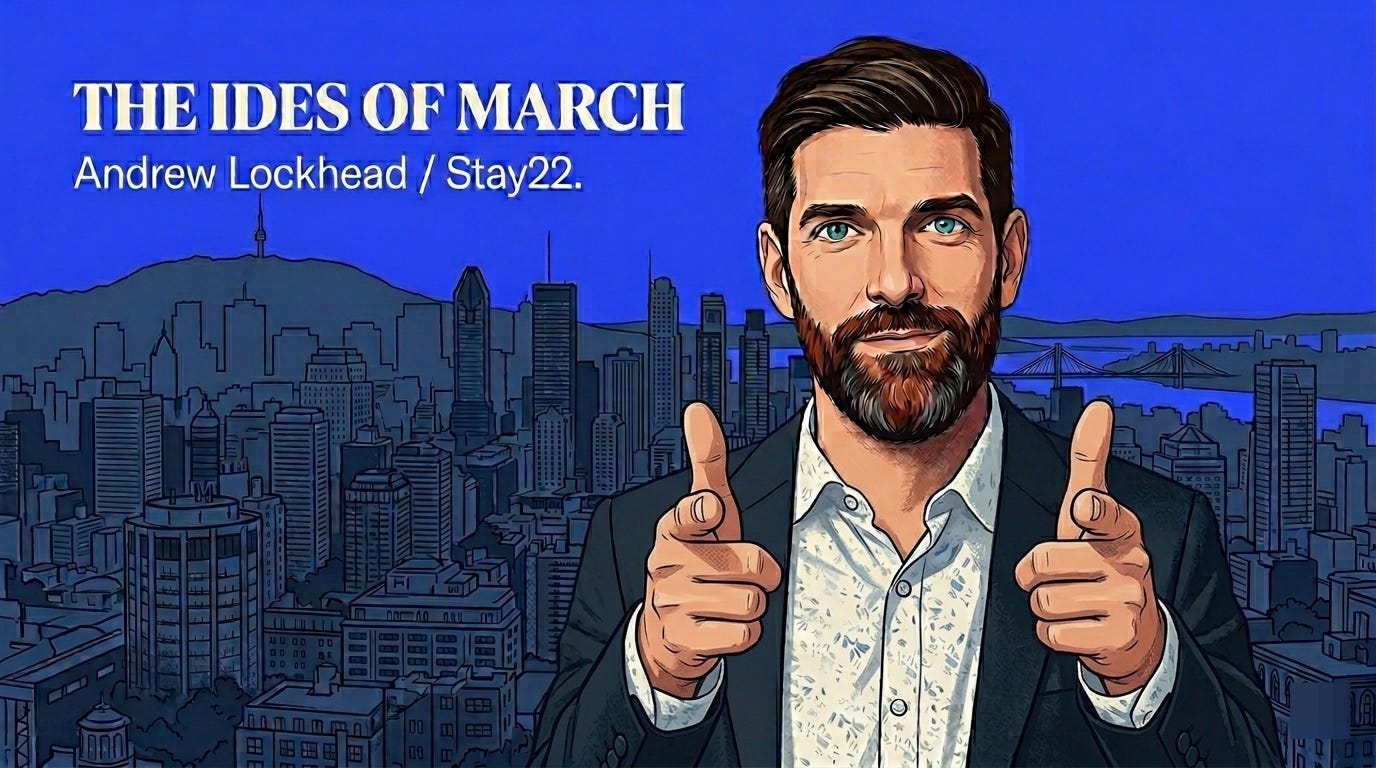
In the late 1990s, in a French-language elementary school on the western edge of the Montérégie, Andrew Lockhead was a gangly boy who never seemed to know where to put his hands. In a classroom full of Tremblays and Bélangers, his name didn’t even sound like a name. He was the mid-year transfer kid with hair pressed flat and glasses so thick they magnified his eyes into wide, unblinking saucers. Fond de bouteille, he’d call them later, coke-bottle lenses. In his first months at the school, he broke them so often that his mother kept a spare pair in the glove compartment, a permanent fixture for the drives she made every few days to the optician.
But before that, there had been Montreal, where Andrew was born in 1987. His father, Pierre Lockhead, held two jobs. One was as a cashier at the Montreal Blue Bonnets Raceway, a horse racing track, where he sat behind the glass of a betting window for full shifts while men pushed 20 cents under the slot, asking for tickets on horses they had picked out of dog-eared programs. His second job was as a mechanic on the floor of a car shop somewhere else in the city, working for someone else. His mother also worked, which meant the daycare Andrew shared with his younger brother sat in the basement of a Catholic church.
The decision to leave Montreal came from both parents, but for different reasons. His mother had begun to worry about her sons’ French. The elementary school they attended in their Montreal neighbourhood had only two children in Andrew’s class who spoke French at home. While she liked the exposure to other languages, she decided her boys were not going to grow up in a Quebec where they could not hold a conversation in their mother tongue. His father had decided that the racetrack window and the back room of someone else’s garage were the last jobs he was going to work for a boss. He had been thinking about it for years. He and a partner bought into a franchise of a Quebec car window repair chain, signed the paperwork on a unit in the West Island, and packed up the apartment. The family moved to Pincourt in the autumn of 1993.
Window Repair Shop
Montreal to Pincourt is a short 20-minute drive on the highway if traffic is moving. In the early ‘90s, it was suburban, quiet, and still small enough that the new subdivisions ended in farm fields and the elementary schools sat on lots big enough to play soccer behind. Andrew’s father opened the first garage and it did really well. Within a few years, he had opened a second one, then a third, then a fourth, scattered across the West Island and the eastern side of the island of Montreal.
The family’s life began to change in ways that were measurable at the level of materialism. Andrew’s younger brother went to private school, his father bought a car that started on the first turn of the key, and they began going on vacation. His mother stopped working outside the home and became the headhome, the role of a Quebec stay-at-home mother who had effectively been promoted into the operations manager of the household. She drove the boys to school in the mornings, packed their snacks, made dinner, and drove Andrew, every two or three days, to the optician.
The trips to the optician started almost as soon as Andrew arrived at the new school. The pair of glasses he was wearing the day he started would rarely be the pair he was wearing the next week. The frame would come back bent at an angle his father could not straighten by hand, with a lens cracked, or with the bridge snapped clean in half. His mother kept a spare pair of glasses in the glove compartment of her car for the inevitable moment, which arrived several times a week, when she had to drive him from school back to the strip mall off the main road. The optician there had come to know the family by name. He performed the repairs, usually temporary ones that would hold the frames together until Thursday or Friday, at which point Andrew would be back in the chair waiting for the next adjustment.
The protector in the family was Andrew’s brother, who was two years younger and built closer to the ground. He could absorb a hit and keep walking in a way Andrew never could. When Andrew was 9 and coming home with broken glasses every other day, his brother was 7, and he was usually the one who stepped in and stopped the fights before Andrew even had to be in them. He is a firefighter in Montreal today, continuing to protect the innocent.
The fights eased toward the end of Andrew’s second year at the new school, and the easing happened without any single triggering event Andrew can remember. There is no scene in his telling where he stood up to the lead bully, won a fight, or said the right thing at the right moment. The fights simply slowed down as other targets emerged in the schoolyard. His glasses would still break and his mother still drove him to the optician, but the frequency went from several times a week to several times a month, which was by the standards of the household at that point, an enormous improvement.
He was around 10 when his father first brought him out to the garage to work on a Saturday morning. His brother came along too. The Saturday-morning trips would continue, in one form or another, for most of the next decade of Andrew’s childhood. However, there was no pay attached. His father had decided early on that a trade was not something to be learned for a wage. The boys were there to learn, and the money, if it came, would come later. They were not paid for the first four years.
The garage itself was a single-story franchise unit on the edge of a service road off Highways 20 and 40, with two service bays at the back and a small customer waiting area at the front. The smell of the place, the same in every garage Andrew’s father would later open, was the smell of motor oil, burnt drip-coffee, and the rubber of new tires waiting in the corner. There was a counter at the front, and behind that was a glass partition through which the customer could see the bays where the cars sat on the lifts. Andrew and his brother spent most of their Saturdays in the front. They stood behind the counter, handling customers, taking phone calls, writing up estimates, and walking buyers through the catalog of windshields and radios.
The back part of the garage, unfortunately, was something his father could not seem to master. The mechanics his father employed in those years were, by Andrew’s account, poorly paid and poorly trained. He had pieced together this picture from what his father said about them at home and from what he could see on Saturday mornings, when the previous day’s unfinished work was still sitting in the bays. They would routinely fail to show up on Fridays after spending Thursday night drinking the previous week’s wages, shouting at customers when his father stepped away from the front counter, and taking longer on simple repairs than the work actually required.
The lesson Andrew took from those Saturdays was that the front and the back of a small business were not the same operation. The front was where leadership lived and where outcomes could be shaped. The back was where culture either worked for the owner or against, and in his father’s particular industry, the back was a labour pool his father could not change no matter what he did at the counter. By the time he was a teenager, he had decided that whatever business he eventually built would not have a back like that.
StudentSphere
The decision to leave the French school system for an English-language CEGEP was made in a series of conversations with his parents and a career counselor over the months before he turned 18. His father wanted him to come into the family business once he finished school. The counselor told him that the best thing he could do before joining anything was to get a credential that would not close any doors for him later. His father agreed. The question then became which institution to attend, and Andrew chose John Abbott College, the English-language CEGEP in the West Island. The practical reason was that he could not speak English and was going to need it for any business career the counselor wanted him to keep the door open for. The less practical reason was that John Abbott was a place where almost nobody he had grown up with would be enrolled. Out of his entire French high school, only one other student had decided to go. The idea of arriving somewhere where nobody knew him was the kind of fresh start his elementary-school self would have wept with relief to see coming.
The glasses came off the summer before he started at John Abbott. The standard medical advice for laser-correction surgery in those years was to wait until the patient was at least in his 20s, but Andrew’s prescription was bad enough that the surgeon was willing to take him on early, and his father had a contact through the garage who could get him into a private clinic. His father wrote a check for $12,000 and told his son to be at the clinic in the morning. The procedure worked. Andrew arrived at John Abbott orientation a few weeks later without the glasses, presenting a face that the kids he had grown up with would not have immediately recognized at a distance.
His first English class was humanities. He sat down at his desk. The teacher began to speak, and Andrew, who had not spoken English to anyone in his life beyond a few phrases of broken classroom translation, watched the teacher’s mouth move and understood almost nothing. The other students were opening their textbooks and writing notes, but he had no idea what they were writing. He sat through the rest of the class with his hands flat on the desk in front of him and asked himself, in French, what he had just done to his own life.
He waited for the bell to ring and the room to empty, then walked up to the teacher and explained, in French, that he could not follow. The teacher did not speak French. They communicated through hand gestures and broken phrases, eventually arriving at an arrangement: Andrew would come find the professor before every exam and during office hours to work through the material together, line by line, until he understood enough of it to write the test. He did this with every class he took for the first semester, and eventually graduated on the dean’s list.
He applied to every business school in Montreal after John Abbott. McGill rejected him. The John Molson School of Business at Concordia rejected him. HEC rejected him. The only school that accepted his application was ESG-UQAM, the management school at the Université du Québec à Montréal. Andrew was missing a math credit from his time at John Abbott, and ESG-UQAM was the only school willing to admit him, on the condition that he take the missing course as a remedial requirement during his first year. He took the offer. The commute from his parents’ house in Pincourt to the downtown UQAM campus was a 1.5 hours each way on the highway and the metro, which meant that on days he had a full class load, he was on the road for three hours and in the classroom for three more. He kept his grades up. He also began looking with an intensity for something to do with the hours he was spending in the city that were not the hours he was spending in the classroom.
The first day of his first frosh week at UQAM, at a beach party the business student association had organized on an island in the Saint Lawrence, he saw a man standing at the grill flipping burgers with a walkie-talkie clipped to his belt, clearly the person in charge. Andrew watched the man for some time. Then he walked up to him, with a confidence that had not previously appeared in any other domain of his life, and told him plainly that he was going to do his job in two years.
Three years later, Andrew was the president of the student association of his faculty, an organization with roughly 12,000 members, a budget of $2.5 million, a coffee shop, a career center, and an annual calendar of events that included regularly booking Metropolis, a Montreal venue with a capacity of 2,500. He took over the events portfolio in his second year, before he took the presidency, and the first major event he ran almost broke him. A week before the show, which he had personally guaranteed against the association’s budget, they had sold almost no tickets. He went home on the Sunday night before the event certain that on Friday, he was going to be the youngest student association officer in the history of UQAM to bankrupt his union. Andrew worked 15+ hours every day of that week promoting the event, until he could sell every ticket he possibly had. The show went off as the biggest party UQAM ran that academic year. Andrew sat in the dressing room afterward with the production crew and understood for the first time what kind of work he wanted to spend his life doing.
He also got dragged through two strikes during his time at the association. The bigger of the two grew out of the 2012 Quebec tuition fight, in which the provincial government had proposed an increase to post-secondary fees and the Quebec federation of student unions, the FEUQ, had called the universities into the streets. The students Andrew represented at his business faculty were mostly opposed to the strike. They were going to pay their own way through school, so the increase did not register to them as an existential threat, and most preferred to keep going to class rather than spend a semester on the picket line. The other faculties at UQAM saw it differently. Strikers from sociology and political science came into the business school building and tried to disrupt classes. They formed lines outside the doors of his faculty’s lecture halls. The police got involved. Andrew, 24 years old, spent that semester in a series of negotiations he had not expected to be conducting, with student leaders from the other faculties, with the university administration, and with his own membership. He treats the experience now as the closest thing to running a real business that an unpaid undergraduate job could have given him. He had to manage stakeholders whose interests did not align. He had to figure out what each of them actually wanted, which was sometimes power, sometimes recognition, and sometimes a line on a resume they could use to apply for jobs later, and he had to lead them on that basis.
The pain point that produced his first real company was something he had been living with every week of his presidency. To sell tickets to events his association ran, he had to stand in the corridors of UQAM at 8 a.m. with a cash box, calling out to students walking past, taking bills, making change, and counting receipts at the end of the day. Ticketmaster did not serve the student market in 2012. Eventbrite had launched but had not made it deeply into Quebec. Andrew and a friend from university decided to build the platform themselves. They called it Sphère Étudiante, also known as StudentSphere. They put in $5,000 each and received a small grant from Fondation Montréal Inc, the foundation now known as Bonjour Startup Montréal. With the starting capital, they paid an outside Montreal development shop $40,000 to build the first version of the product.
Outsourcing the technology is the decision Andrew now points to as the most expensive learning of his early years. The platform shipped and worked, but when they wanted to add features the next year, the same shop quoted them $120,000. By the third year, the architecture they had paid an outside vendor to build had reached the point where it could no longer be extended. Whatever ambitions Andrew and his co-founders had for the company were constrained by a technology stack they had bought but did not own. StudentSphere continued for ten years as Andrew and his co-founders eventually moved themselves off the payroll, hired a General Manager, and reduced their own involvement to occasional board calls. The company was sold in 2022 to a UK firm that wanted the technology for a North American expansion, for an amount that came out to less than $100,000 for all the founders, on roughly a decade of work.
Stay22
In the summer of 2014, while continuing to work on StudentSphere, Andrew attended Startupfest, the annual conference held in the Old Port of Montreal where the Canadian early-stage technology ecosystem assembles for three days every July. Andrew was sitting in the audience watching a young engineer named Hamed pitch a B2C travel company. Hamed had been kicked out of Dawson College a few years earlier for hacking the school’s system, and he was building a product designed to take on Expedia, Booking, and Kayak directly. Andrew was impressed by Hamed, but he was unimpressed by the strategy. He introduced himself after the pitch and told him, to his face, that he was wrong about the whole premise of the company. Going B2C against the incumbents in travel, who spent more than $10 billion a year on marketing budgets between them, was not a winnable fight no matter how good the product was. The right way to compete in travel was to embed inside the distribution channels where people were already making travel-adjacent decisions, the platforms where they were already buying tickets to events.
They reconnected a few years later. They tested working together for a month, selling a few event integrations, and then applied to Travelport Labs, the corporate accelerator run by the global distribution system Travelport. Travelport accepts only five companies per year. They got in and moved to Denver for four months during the winter of 2016 into 2017. Andrew, who was so broke that he had convinced himself he hated traveling, got a crash course in an industry he had previously known nothing about. He learned the suppliers, the global distribution systems, the commission structures, and the way affiliate revenue flowed from a booking back through three or four layers of intermediaries. Travelport invested US$35,000 for 8% of the company. While that may seem expensive, the founders did not negotiate, as the education was worth more than the check.
The next accelerator they entered was FounderFuel, the Montreal-based program Andrew had previously applied to with StudentSphere and been rejected from. With Stay22, he and Hamed made it in. The terms were $200,000 for 5% of the company, paid in two tranches across a 12-week program. The team grew from two to six during the cohort, with two new hires from Hamed’s network and two of Andrew’s former UQAM classmates. Andrew paid everyone, including himself, $1,000 a month. He was 29 at the time. He owed his parents $10,000 from previous loans he had not been able to repay, and he was living on ramen and the half of the rent his girlfriend (now fiancée) was paying for him. Somewhere in the middle of that year, on the theory that if Stay22 failed he was going to need a stable career, he applied to become an air traffic controller, and washed out of the training program.
FounderFuel ended in the autumn of 2017 with a demo day pitched in front of an audience of 2,000 people. Andrew and Hamed had been told by a FounderFuel mentor named Isaac that a seed-stage startup raises money on one of three things. The first was a powerful vision the founder could articulate well enough that an investor would buy the story before the numbers existed, and Andrew was not, by his own admission, a strong vision storyteller. The second was pedigree, the kind of resume that read “Stanford” or “former Google engineer” across the top of the deck. Hamed had been kicked out of Dawson College before he finished his degree, and Andrew had only barely finished his own at UQAM, which meant the second door was closed to them as well. The third was traction, and that was the only path left. They were the first team in the building every morning and the last team to leave every night, every working day for the full duration of the program.
They closed a seed round on the strength of the demo day numbers: $750,000 at a valuation of $3.75 million. The lead investor was Seven Gates Ventures, a fund out of Vancouver that Andrew chose partly because the firm had the kind of West Coast network he and Hamed lacked. Real Ventures, the Montreal-based seed fund, also came in. So did several angel investors who had found their way to Stay22 through Anges Québec, including one who had moved to Montreal from Italy and had no obvious reason to be writing checks to a Canadian travel startup, but wrote one anyway.
Ides of March
By February of 2020, Stay22 was doing $110,000 USD in monthly recurring revenue and the team had grown to 24 people. A new financing round had been negotiated, term sheets were signed, and several investors had already wired their commitments. Andrew was 33 years old. He had spent more than a decade getting to the point where he was about to fundraise his way into the version of his career that other founders in his cohort had been living for some years.
The pandemic arrived in the second week of March. Stay22 sat at the intersection of travel and events, the two industries the global economy was about to close completely, and revenue fell 90% in a matter of weeks. The cash that was supposed to fund the next 18 months of operations had only partly landed in the company’s bank account. The investors who had committed but had not yet wired their tranches now made the calculation that the company was about to go bankrupt, deciding they would prefer to keep the money rather than send it.
Andrew called them. The first calls were polite, and the investors told him the money was coming next week. The next week came, but the money did not. His follow-up emails went unanswered, his calls began going to voicemail, and by April, he could no longer reach them at all. One of them, who was already on the cap table as an angel investor, told Andrew, when he finally got the man on the line, to sue him if he wanted to but that he was not sending the money. Another sent a paper check with written instructions not to deposit it on the grounds that there were no funds in the account it was drawn against. Andrew kept the check on his desk. He still has it, sitting next to his monitor as a daily reminder of never celebrating until the money hits the bank.
He had to take legal action against the investors who had signed and refused to wire. The lawsuit was not, in any meaningful sense, a recovery exercise. As a director of the company, he had a fiduciary obligation to the investors who had wired, the ones who had stood by him, to demonstrate that he had pursued every available legal remedy against the ones who had not. If he failed to do so, those supporting investors would have had grounds to sue him personally for the duty he had not discharged. After filing and opening up a case, he moved on to the question of whether the company would continue to exist.
He cut the team from 24 people to 8. The conversation he comes back to when he tells the story of that period was not with any of the laid-off employees, but with his accountant, a man named David at a Montreal firm called Finalytics. David had been billing the company close to five figures a month for the work he did on the books, tax filings, and regulatory paperwork. In the spring of 2020, Andrew and his COO, Simon, sat across from David and delivered the news that the company could no longer pay. Andrew had no idea when, if ever, he would be able to clear the debt, but the work still had to be done because the company had no operations team left to do it. David could have stood up, walked out of the meeting, and quit on the spot, and Andrew would have had no leverage to keep him. Instead, David agreed to keep working without compensation for an undefined period, on the strength of a relationship he and Andrew had built over several years. Six months later, when revenue had begun to return, Andrew started paying David again. Andrew believes that if David had walked out of that meeting and quit, Stay22 may not have survived. Without accounting and daily cash flow projections, Simon wouldn’t have a single hair left.
The remaining investors told him to keep going. He sat down with what was left of the team in the spring of 2020 and ran a two-week brainstorming sprint. They built three minimum viable products. The first one failed within days, and the team shut it down before they had spent any meaningful time on it. It was a map-based product for nurses and doctors who needed accommodation near hospitals they had been temporarily assigned to during the early months of the pandemic. The Quebec government, which they would have needed as a partner to make the product function at scale, did not move at the speed a startup needs from its partners, and the idea died.
The second was a cross-sell product for e-commerce stores on Shopify, which offered travel-adjacent services to customers who had just purchased something from a Quebec apparel brand or wellness company, like Prana, Ciele, Poches & Fils, or Café Liégeois. The product worked in the sense that it generated revenue, but the unit economics did not scale, and the team eventually let it go.
The pivot that worked emerged from a parallel set of conversations Andrew had been having with Quebec content creators who had stopped traveling internationally and had begun rediscovering their own province. The travel bloggers wrote about the rediscovery first, the Instagram accounts came after them, and the YouTube channels arrived last. Stay22 had a map-based product designed for events, but the bloggers did not want a map. Andrew sat down with them in workshops he ran personally over the course of two weeks, while Hamed coded in the evening what they had discussed in the afternoon. Every morning, Andrew presented the wireframes to the creators and noted their reactions, and they iterated again. By the end of the two weeks, the team had their third minimum viable product. By the end of the second month, they had product-market fit. The creators wanted a way to monetize the content they were already writing about travel through affiliate links to hotels, restaurants, and activities that appeared in the posts they were already publishing, and they were happy to give a software company access to their websites in exchange for a share of the revenue. This is the version of Stay22 that exists today.
Almost exactly one year later, in March 2021, Andrew learned that Airbnb was shutting down its affiliate program. He saw the news through industry channels before Airbnb officially called him, and for a few weeks, he allowed himself to believe that Stay22, given the depth of its integration with the platform, would be exempt. The phone call came in late March. The Airbnb relationship manager told him that Stay22 had been a great partner and that the team appreciated the work Andrew had done on the API, but that Airbnb’s strategic direction no longer accommodated affiliate partnerships. The company would have 60 days to wind down the integration. Airbnb represented 80% of Stay22’s bookings.
He called his mother, who was in Florida with his father at the time. He told her what had happened, that this was the third near-death event the company had faced in 18 months, and that perhaps the universe was trying to tell him something he had so far refused to hear. His mother told him that nothing happens for nothing in this life, that this was a sign he was supposed to keep going, and that there was a reason for it that he could not yet see.
He pivoted Stay22’s supply layer onto Trivago, the German meta-search engine, and the first month under the new arrangement was extraordinary. The company touched almost $500,000 in revenue in a single month, more than any month it had ever recorded. Andrew began to allow himself to believe that the Airbnb cut had been the best thing that had ever happened to the company. Then Trivago called with a correction to the numbers from that first month. The relationship manager explained that Trivago’s accounting had been overpaying Stay22 for clicks at an unsustainable rate, and that the rate would need to come down significantly.
Andrew was burning $200,000 a month against a runway of approximately three months, and the data did not support keeping the company open. The rational decision, by every framework he had taught himself to apply, was to wind it down and start something else. Andrew did not see the situation in those frameworks anymore. Raising more cash wasn’t on the table, not with a 90-day runway, and certainly not after getting burned by their last investor. He was done looking for a rescue party. Time was the only resource he could not replenish, and starting another company would burn years he could not recover. He was 34 years old, so starting over was no longer something he could treat as a free option. The creator base he and Hamed had spent the previous year building had 90 days to generate enough revenue to save the company. If it did not, he would close Stay22 at the end of the runway and move on.
It delivered. By the middle of 2022, the company was running at roughly $1.5 million in monthly revenue. By 2023, it was profitable, and it has been profitable every month since, doubling in revenue every year for the past five years. The team grew from the post-pandemic skeleton of eight to roughly 125 employees, tripling the team size within two years. Andrew personally conducted the final interview for every hire. He had learned, from an earlier batch-hiring spree that had broken the company’s culture in ways he had spent two years repairing, that hiring more than 15% of a team per quarter was the most reliable way to destroy a small company’s culture. The one-employee-a-week cadence was his answer to that mistake.
Every March since the pandemic, the company has faced some kind of existential threat. March 2020 was COVID. March 2021 was Airbnb. March 2024 was a brutal Google algorithm update that stripped Stay22’s independent content-creator partners of 40% of their search traffic, forcing the company to pivot hard toward major digital publishers who still held sway on the open web. By 2025, a second paradigm shift arrived: the rise of LLMs and AI search began draining traffic away from text-based Google results entirely, sparking a massive exodus toward YouTube, Instagram, and social platforms where creators could build un-scrapable, direct relationships with their audiences. Each March, the question has been the same, and the answer has been to keep going. There’s an opportunity in every crisis that is faced, and at all times, a deep dive should be done to find that opportunity.
Today
In February 2026, Stay22 announced a US$122M minority growth investment from Summit Partners, the Boston-based growth equity firm. The deal was the company’s first institutional capital event since the seed round Andrew and Hamed had closed in 2020. By the time it priced, Stay22 was processing more than US$1 billion in annual transactions and working with more than 5,500 creators. On the morning of March 11, 2021, Andrew had been sitting in his office reading an email from Airbnb and asking himself whether the universe was trying to tell him to fold.
He runs the company today on a set of operating principles that have hardened over time. He implemented the Entrepreneurial Operating System in 2019. He runs the executive team on the framework Patrick Lencioni laid out in Five Dysfunctions of a Team. He recommends Annie Duke’s Quit: The Power of Knowing When to Walk Away to other founders because he believes the harder problem in entrepreneurship is not perseverance but the discipline of knowing when to stop.
The conversation that reset his understanding of his own role as chief executive happened within the past year. He had been trying for two years to be the kind of CEO he believed the company needed at its new scale, a more delegating, bottom-up version of himself, a man who built management systems and trusted his executives to run them. Then, his COO, Simon, asked for a meeting. He told Andrew plainly that the experiment was not working. He explained that Andrew was a wartime founder who naturally belonged inside the details of the business, and that he had been operating against his own nature for two years. He was miserable in the process, and Simon told him to stop fooling himself. Andrew took the feedback, leaned back into the active work, and the company immediately started moving faster.
He lives now in Laval, the town next to the one he grew up in. His daughter will turn 3 and his son 6 this summer. He is home only one evening of the work week, and sometimes none at all. But he makes sure he is home every weekend without exception, and on those days, he does not look at his phone while the children are awake. His brother remains a firefighter in Montreal. His father retired at 53, after selling his chain of window repair shops and reaching financial independence. Today, his parents spend six months of every year in Florida among the other Quebec snowbirds.
Andrew turns 39 this summer. He previously said that he hoped to surpass his father’s success by the age his father retired. With the Summit Partners deal, he has already surpassed his father in raw dollar terms.
But the true difference between the two men is no longer the money. It is that his father retired the moment he had enough, and Andrew has not yet figured out what enough looks like. Maybe in the next few years he will reach the point his father reached. Maybe not. Who knows?
Thanks for sharing this - my favourite line was probably this: "He explained that Andrew was a wartime founder who naturally belonged inside the details of the business, and that he had been operating against his own nature for two years."
Founder-mode activated. Maybe, even bring the Airbnb moment full circle.
Love hearing this origin story 😁