


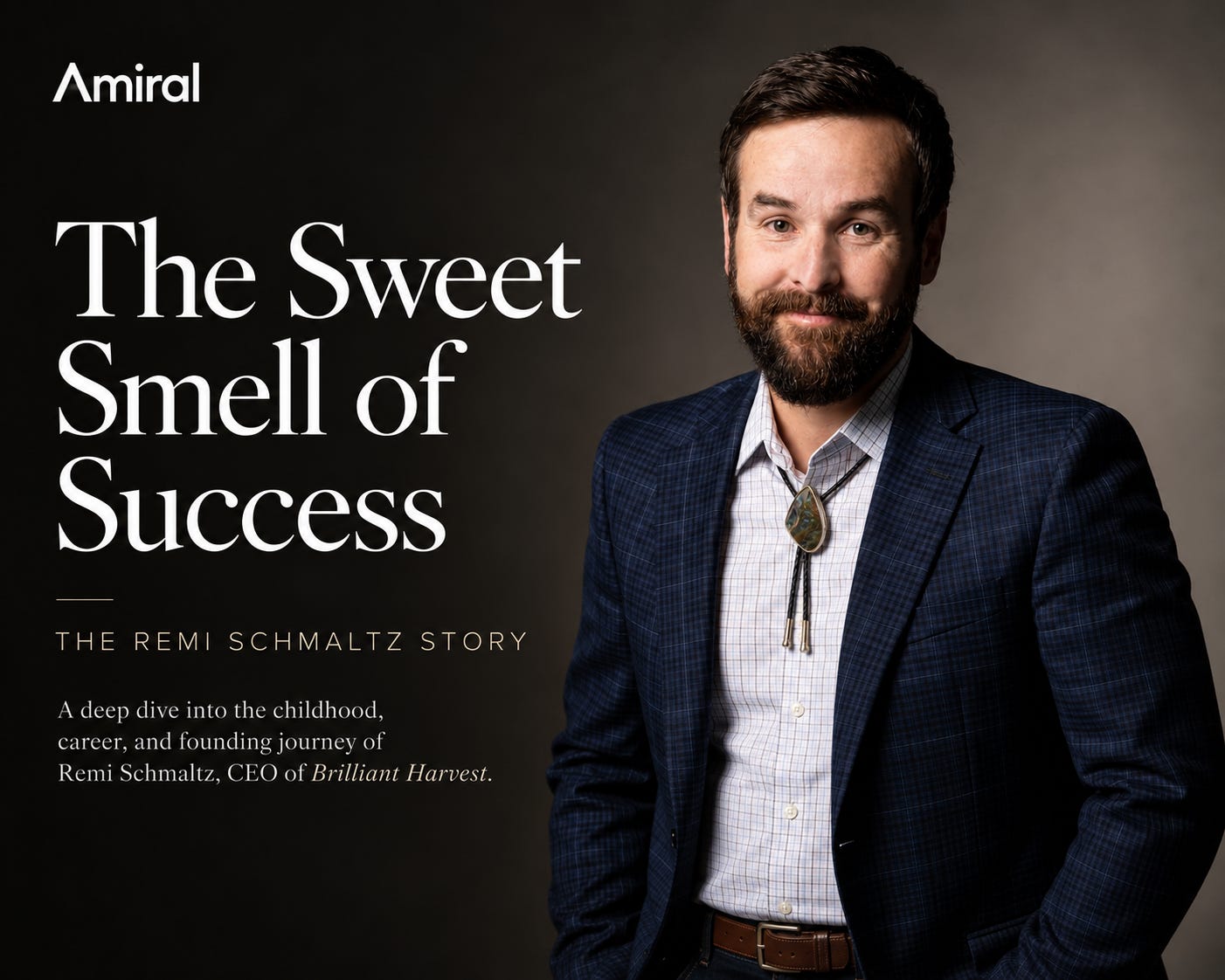
In the episode The Sweet Smell of Success of The Raccoons, a Canadian animated series that ran through the 1980s, a band called the Raccoons had become the biggest act in Evergreen Forest. Bert played guitar and sang, Ralph was on drums, and Melissa on the keytar. When Cyril Sneer, the forest’s resident industrialist, found himself with an unsellable new cologne called Success on his hands, he decided the band was his way out of it. He brought a contract to all of them. Ralph and Melissa and the rest turned him down almost immediately, wary of anything with Cyril Sneer’s fingerprints on it. Bert did not turn him down. Wined and dined by Sneer and his lackeys, promised fame across the globe, a career, a lifetime supply of peanut butter, he signed.
What the contract actually bought him was a series of stunts he never agreed to and never wanted, culminating in a hot air balloon rescue gag gone wrong, Bert dangling from a branch over a cliff edge with nothing under him. Sneer and his men, watching it happen, simply left. No one came from Sneer’s side. Bert sang, alone and off key, that he should have listened to his friends, and it was the friends he had turned his back on, Ralph and Melissa and the rest, who showed up and pulled him back over the edge. The commercial never made him famous, and he barely appeared in it.
Remi Schmaltz was a farm kid outside Beiseker with three channels to choose from, and The Raccoons went out at 7:30 on a weeknight, early enough in the CBC’s primetime lineup that the whole family was usually still in the room. He watched it the way every other kid in the country watched it, week after week, without ever once thinking about the impression it left on him and how he would choose to do business later on in life.
Childhood
The Schmaltz name arrived in Canada by way of the Dakotas, and before that by way of Odessa, in the part of the Russian Empire that is now Ukraine. Late in the 19th century, the family settled just north of Beiseker, Alberta, on land that still demanded a sod hut before it would let anyone build anything more permanent. They farmed first, and the equipment that farming required became a business of its own within a generation.
The company was called Beiseker Motors, a Ford and Massey dealership moving tractors and short line equipment through the boom years of prairie mechanization. It passed from Remi’s great-grandfather to his grandfather and his grandfather’s brothers. His grandfather, a man everyone in the community called “Soup” Schmaltz, noticed something the equipment business alone could not give him. The dealership already had the relationships. Every farmer who bought a tractor from Soup Schmaltz was a farmer who would eventually need fertilizer, and so bagged, granular fertilizer became a side hustle run alongside it.
The equipment dealership was the business with the name over the door. The fertilizer trade started almost casually, to serve customers who were already there. Hard years in the equipment industry eventually closed Beiseker Motors for good. Soup Schmaltz carried the fertilizer arm forward on its own under a new name, Beiseker Agri Services, and ran it successfully as a dealer there for years.
Remi’s father, Soup’s son, left home after high school and disappeared from the family business for the better part of a decade, travelling through Europe and India in the 60s and 70s with no fixed itinerary and, for a stretch, no fixed address at all. He lived for a time in a treehouse in India.
When he finally reappeared, Remi’s father did not settle quietly back into Beiseker Agri Services. He took it over with ambitions that outran what Soup had built, determined to construct a large fertilizer blending plant of the kind he believed farmers would soon need as their operations scaled up. He took the business forward alongside his brother and brother-in law and expanded it from one location to four, adding chemical, seed, and custom application to the original fertilizer line. The company took the name Dynagra.
Remi’s mother’s side of the family came from the opposite direction entirely, east rather than west, and arrived three centuries before the Schmaltzes did. She was born and raised in Quebec City, and her ancestors were among the first French soldiers to arrive on the continent in the 1600s. Outside of First Nations lineage, he says, he might be as Canadian as it is possible to be. When she eventually made her way to Calgary for school, she arrived speaking only French. Learning English was part of the reason she came.
She became the stay-at-home mother of three sons. “Busy” is the word Remi uses to describe the job. Tasha came first, two years older than Remi. Justin came last, seven years younger.
Between Remi and Tasha there was closeness rather than rivalry, and Remi credits at least part of that to the fact that his older brother was, by then, a two-time national judo champion. There was not, he says jokingly, a great deal of fighting. He submitted to the will. The two of them ran in the same social circles, shared friends whose younger siblings became Remi’s own friends, and spent long stretches of adolescence together in an old shed on the property fitted with a pool table, hosting what Remi calls shaker parties that sometimes drew a couple hundred people. Risk was played. Cards were played. Pool was played more or less constantly.
Beiseker, when Remi was growing up there, had a population not far off from what it carries today, roughly 800 people. He went to Beiseker High, a school with roughly 100 students total, small enough that everyone knew everyone, and everyone’s parents, and by extension everyone’s business.
He was 13 when his father bought a snowmobile for the farm, one of the big sleds from a heavy snow year, and Remi decided he wanted a different one. He called a dealership in Calgary, found a salesman, and worked out a trade over the phone. The salesman had no idea he was talking to a kid. A few days later Remi and his father drove into the city to close the deal, and when Remi found the man on the floor, the salesman looked at him and said, “Sorry, were you the guy on the phone?” Remi said “Yeah, yeah, we had this deal.” The salesman looked at Remi’s father, then back at Remi, and said, “Oh my god!”
He was, by his own description, the kid who always won the door-to-door fundraiser sales, frozen food and whatever else the school was pushing that particular season, out on his bike, dirt bike or quad depending on the terrain, selling relentlessly and taking home the prizes for it. He liked the challenge of it and was never afraid to knock on a stranger’s door, so long as he did it, in his phrase, in a respectful way.
In high school, he rebuilt a 1954 Chevy from the ground up.
University
He enrolled at the University of Lethbridge in a general management program. He didn’t know what he wanted to do, so he picked something general, and marketing sounded interesting. He liked the idea of why people buy things.
In his third and fourth years he wrote business plans as class assignments. Instead of inventing hypothetical companies, he wrote plans for real initiatives inside Dynagra, the family business, plans that got implemented after he graduated and went on to generate millions of dollars in revenue. His professor gave those papers a D-.
He asked the professor if the plan was written poorly. “No, it was written fine,” the professor said. “So why the grade?” It turned out the professor knew nothing about the fertilizer industry and had never spoken to anyone in it. So how, Remi asked, was he even evaluating this.
Remi was never known for his academics, and he lost a lot of respect for the school system after that. What he got out of university was the relationships. To this day, some of his closest friends and best contacts are people he met there, people he has since built businesses and gone on adventures with.
It was also where he found the outdoors. Growing up he skied maybe five or ten days a season. At Lethbridge he joined the volunteer ski patrol at Castle Mountain, a couple hours away, compressing his classes into two days a week so he could live up at the patrol shack the other five, going out on avalanche control runs with the rest of the patrol. He calls it glorious. It was there that he also picked up whitewater canoeing and big game hunting.
The Family Enterprise
Life did not wait for him to finish deciding what he wanted to do with it. While he was still an undergraduate, his son Sage was born. He was engaged to marry Dominique, the woman who would become his wife. He had a mortgage and a minivan before he had a diploma. He described himself as a bit of an overachiever, shot out of a cannon, life arriving all at once rather than on any negotiated schedule.
His father had retired from Dynagra by then, leaving the business under interim management. “Just come work on some projects,” his father told him. He agreed, and found himself hooked almost immediately, not on any particular industry but on the underlying activity of business itself: identifying a real problem, understanding it, and building the thing that solves it.
His first real assignment was building out a finance division inside Dynagra to support the sale of crop inputs to farmers, work that put him directly under the mentorship of a retired executive from Farm Credit Canada who had built that organization’s own lending program from scratch.
Meanwhile, in a different corner of the same company, Tasha had begun experimenting with precision agriculture and variable rate technology, the practice of using field data to vary how much fertilizer or seed gets applied across different sections of the same field rather than blanketing it uniformly. The two brothers and Garth Donald, their head agronomist, gravitated toward that division together, hired people into it, and eventually filed patents on the technology. They realized that they were more passionate about the technology itself than the underlying business of selling crop inputs to farmers.
So in 2012 they sold the crop input business, the one their great-grandfather and grandfather had built, to CHS, the large American cooperative, and rolled the technology division, which had been operating under the name Dynagra VRT, into a new and independent company. They called it Decisive Farming. It is the moment Remi identifies as the real beginning of his startup life, even though nothing about how it started resembled the mythology of a garage-founded startup. They had nine or ten employees already in place, office space, and customers. Nobody in the room ever said out loud that they were doing a startup. They had a product they believed in, precise placement of fertilizer and seed using satellite imagery and soil ground-truthing, delivered through equipment the farmers already owned, and it already worked for the customers using it. The plan, insofar as there was one, was simply to keep going.
Decisive Farming
Keeping going turned out to be harder than the momentum of the spinout suggested. Growth was slower than they had projected, and it became clear almost immediately that the business would need outside capital in a way the family enterprise never had. Remi found himself at Randy Thompson‘s angel investor bootcamp in Calgary, absorbing an entire vocabulary of pitching, SAFE notes, and convertible notes that he had approached with essentially zero prior fluency. It felt, he says, like “drinking from a fire hose.”
The Canadian capital ecosystem of that period, roughly 2013 and 2014, did him few favours. The angel network and the family office community were, in his blunt assessment, weak and thinner than they are even today, but he ended up finding the lead investor for the company’s first meaningful round not in Calgary or Toronto but in the United States. Decisive Farming would go on to raise four rounds of capital in total, the first two angel-led and the latter two institutional, with McRock Capital leading the Series A in 2016, a relationship with McRock’s Whitney and Scott that Remi describes as still warm today. He is pointed about the exception to an otherwise clean cap table. In its seed rounds, the company raised capital exclusively from American investors, apart from friends and family. The only exception was a single Canadian angel investor who participated after the round was already closed and oversubscribed. He does not disguise his frustration with what that says about the domestic investment climate. Canadians, in his view, are simply too conservative with early capital, and it is an ecosystem-level problem rather than a personal grievance.
Building the technology itself required solving a gap neither brother could close on their own. Tasha was not, and is not, a software engineer, and Remi is candid that finding someone who could actually translate their domain knowledge into a functioning product took considerable trial and error, cycling through people before finally finding Marc Wachmann out of Calgary, the technologist who Remi credits with getting the business to where it needed to be from a purely software standpoint. The first customer, when it finally arrived, came from the same well the family had always drawn from. A farmer who had already been a customer of the crop input business was simply asked whether the new variable rate product made sense to him. “It did,” he said, “let’s try it.” The trust economy of Beiseker, again, doing its work at scale.
The near-death experiences, when they came, were less about product-market fit than about the sharp elbows of a small, well-funded competitive field. A well-capitalized rival threatened lawsuits outright, and Remi describes navigating a period of what he calls bullshit poker with them, both sides bluffing about legal exposure neither fully wanted to test. That competitor had acquired a patent on related technology and began telling conference audiences, in blunt verbal terms, that it intended to sue everyone in the space. Remi received a cease and desist letter from them directly. Shortly afterward Decisive’s patent was issued to them giving them room to manoeuvre, and Remi responded by sending a cease and desist of his own, an aggressive counter-move that led, improbably, to an invitation from the competitor’s investor, a large Silicon Valley fund, to fly down and sort the whole thing out in person. The meeting was informal enough that Remi describes it as shooting the breeze, and it ended with both sides agreeing, in essence, to mind their own business and leave each other alone. He draws a lesson from the episode that has stuck with him since. Patents in a startup context, in his view, function best as a defensive strategy rather than an offensive one, a shield rather than a weapon, and that the same aggressive competitor eventually had its patent squashed by another rival purely, as far as he could tell, out of spite. The industry, in other words, punished the very tactic it had tried to use against him.
Through all of this, Remi maintained a philosophy of staying deliberately friendly with competitors rather than treating every interaction as zero-sum, and it paid an unexpected dividend years later. At an industry event, he ran into Todd Ormann who at the time worked at that competing firm. Remi and Todd had a positive discussion as competitors. Years later Todd was the first agriculture employee at TELUS. Todd reached out to Remi to explore a potential partnership. His first instinct, by his own admission, was suspicion, the old worry that a big incumbent circling a smaller company is there to extract what it knows and then walk away. Todd did the opposite, over 6 months they had numerous meetings exploring a partnership opportunity that eventually led to Todd expressing interest to acquire Decisive Farming. It was that they respected the value Decisive Farming had built for farmers, and wanted to be part of extending it.
TELUS
TELUS’s acquisition approach came in March of 2019, over the phone, and Remi’s first response to it was no. He had, by then, developed a working framework for evaluating any offer against three simultaneous obligations:
(1) what it meant for shareholder value,
(2) what it meant for customers,
(3) and for its team.
A deal, in his view, only made sense if all three constituencies came out ahead together. An acquisition that served investors at the expense of customers, or vice versa, was not a deal worth doing regardless of the number attached to it.
It took roughly a month of back and forth before the conversation moved anywhere real, largely around whether a potential transaction could clear the return threshold his existing investors would actually require. Once that hurdle looked surmountable, TELUS put forward a letter of intent, and the following six weeks were consumed by negotiation over its terms. A deal appeared with a close date projected in August, but TELUS’s restructuring around hybrid tax treatment intervened, adding a further and, in Remi’s word, painful stretch of delay to a process that had already run almost a year.
It was during this stretch of prolonged limbo that Remi did something small and, in its way, perfectly characteristic. He had been clean-shaven his entire life up to that point. In early September, as the end of August deadline he had been promised slid by, he stopped shaving. Every additional week the deal dragged, his beard grew a little longer. People at the table started asking him about it. “What’s with the beard, Remi?” He would point to it and tell them “It’s taking you this long to get the deal done.”
The deal finally closed on December 12, 2019, the beard by then fully grown in. TELUS acquired Decisive Farming in a super successful exit being awarded as the most significant transaction that year, good for the team, good for customers, good for investors, the kind of outcome the three-part framework he had insisted on from the outset had actually managed to deliver.
He stayed on with TELUS’s strategy team for a couple of years after the acquisition closed, and it was the first time in his working life he had ever operated inside a genuinely large corporation. TELUS acquired 14 agriculture and food companies during his time there, a scale of integration complexity that had no analogue in anything he had built himself. He is generous about the culture he found there, and clear that he believed in the direction the company was trying to go. But he felt a mismatch almost immediately. He is, in his own repeated phrase, a “get stuff done” kind of guy, someone whose sense of purpose is bound up in visible momentum, and it became apparent fairly quickly inside a large corporation that individual momentum was not really how the work there was structured to happen. He did not experience this as a betrayal or a failure on anyone’s part. He experienced it as information and began quietly planning an exit of his own.
Before that plan could fully mature, the accumulated toll of the preceding years caught up with him. He had burned out once already, in 2017, in the run-up to the Series A, a hole he says took him roughly two years to climb fully out of. The TELUS acquisition process and its aftermath dug a second one. He and his family took ten days over Christmas in Belize to go sailing and to disconnect.
Whitewater Trip
The world outside his own recovery was simultaneously navigating the early months of the COVID pandemic, which he notes made an already disorienting period feel stranger still. He spent much of that stretch mentoring other founders through Thrive and Creative Destruction Lab, work that gave him proximity to other people’s problems without requiring him to solve any of his own, and it was in the course of that mentoring, watching other entrepreneurs raise capital and structure deals, that he arrived at a conclusion about what he personally still needed to learn.
If he was ever going to start another company, he needed to understand the investment side of the business first. Without that, and especially as a Canadian founder, you are hamstrung relative to your American counterparts. So he made a deliberate effort to network inside the investment community itself, to learn the mechanics from the inside rather than across the table.
The result was Koan Capital, launched with a $5 million fund that got raised in seven weeks, an unusually fast fundraise built around a pre-seed and seed stage agtech thesis, funded entirely by non-institutional capital, and currently deployed over 4 years across roughly 18 companies spanning Canada and the United States. He describes the experience as extremely rewarding on terms that have little to do with the eventual returns. He learned, and continues to learn, from the entrepreneurs and co-investors he works alongside, in a way that fed directly and consciously into what he built next. Brilliant Harvest, when it finally arrived, did not spring from nowhere. It came out of a period of study he had specifically engineered for himself, and by his own account it started, quite literally, on a napkin.
The napkin sketch found its final shape on a whitewater trip in Idaho in the summer of 2023.
He was on the South Fork of the Salmon River with his son Sage and roughly six other people, running a multi-day Class V stretch he had been building toward for years in his own paddling career, in the twelve-foot cataraft that had become his boat of choice. His oar caught a rock in shallow water, shot upward, and struck him squarely between the eyes. He had never had a concussion before, and on a multi-day river trip far from any hospital, the only person who can reliably diagnose one in the field is the person who has it. His group asked if he was okay, but nobody actually said the word ‘concussion,’ so he kept paddling.
The following day, on a gentler stretch of the main Salmon, his guard was fully down. He had lent his boat to one of the other kids, and while joking around near his son’s kayak, he tried to flip it as a prank. His son reflexively swung the paddle back and caught him in the side of the head. What followed was, in Remi’s own words, a series of bad decisions. He got into a kayak he had no real business paddling, since he does not have a roll, swam once, and was approaching the biggest rapid on the stretch when one of his son’s friends, a genuinely excellent kayaker who happened to be twenty feet ahead of him, looked back and told him, “I’ve got you, Remi.” They made the line. It was not until breakfast afterward, at an old-fashioned diner with pen-and-paper ordering, that the injury actually announced itself. The waitress asked what he had ordered. He had no idea. That was the moment he knew.
The recovery period that followed, weeks of no screens nor reading, is where Brilliant Harvest was actually born. Remi is unapologetic about how loosely he interpreted his doctor’s instructions. He was cleared to do anything that did not hurt, and he took that as licence to keep talking to people even while he stayed off screens entirely. In the quiet, he ran a private diagnostic on himself, three questions he kept coming back to.
What am I good at? What do I know? And where is the money — meaning specifically where is the money attached to an unsolved problem?
He knew agriculture and was excellent at sales. What he needed was the third piece, the actual problem, and it arrived from a familiar source. Doug Heritage, a Manitoba farmer who had been a Decisive Farming customer years earlier and had since become a genuine friend, was complaining to him about how painful dealership service had become, how expensive and scarce good technicians were, and how a farmer could spend well over a million dollars on a single piece of equipment and still struggle to get a straight, timely answer to a basic operating question.
The timeline that followed moved fast for a man supposedly convalescing from two concussions in two days. The second injury happened on July 5th. By July 15th he had validated the problem, talking to farmers, dealer experts, and people across the equipment industry. By the end of the month, Mark Blackwell at Builders VC, who had spent a few months sharing ideas with Remi that never panned out, agreed this one did fit, and offered to write the first cheque. The company was incorporated on August 1, 2023.
Brilliant Harvest
Brilliant Harvest is built to solve a specific and, once explained, obviously enormous problem. An equipment dealership might carry and support 20 to 100 different brands, an amount of technical knowledge no individual employee could realistically hold in their head, compounded by manuals that can run to 12,000 pages for a single model. Over 50% of the questions a farmer brings to a dealer are repeats, or easily answerable, but during planting and harvest, when every farmer in the region needs help at the same moment, even the easy questions become bottlenecked behind busy staff, and staff themselves often have to search across half a dozen internal systems just to locate the answer.
Brilliant Harvest’s platform ingests a dealer’s full library of equipment manuals, connects directly into the dealer’s business systems to pull work order history, parts usage, and customer records, and processes conversational data from call centres and internal technician group chats where informal best practices already circulate. Out of all of that it builds a proprietary, dealer-specific knowledge base, an asset that belongs to that dealer.
The near-crisis Remi identified in the company’s first two years was not financial or competitive but philosophical, a question of restraint. Everyone in the industry, he says, was talking about AI, and very few were implementing it in any way that was actually profitable or sustainable as a real business. The temptation he had to resist, repeatedly, was over-engineering the product with AI where a simpler interface would have served the customer better. Humans, he points out, are pretty capable on their own. Give someone a couple of buttons to choose from and they will pick correctly almost every time, in situations where asking an AI system to correctly infer the same intent from open text is a genuinely harder problem to solve reliably. Given the stakes involved, heavy farm equipment where an unreliable answer carries physical risk rather than mere inconvenience, the company has erred deliberately toward conservatism in what it deploys to production.
Part of why he trusts the team to make that judgment correctly is who is on it. Five members of the founding team had worked with him previously at Decisive Farming, and the leadership team is proven with deep domain expertise, giving the company an unusual head start on internal trust and communication. The Head of AI, Micheal Lanham, had already authored roughly a dozen books on applied AI development, including two specifically on deploying AI agents, and Remi still seems pleased, almost surprised, that he found someone with that particular depth of expertise sitting in Calgary.
Brilliant Harvest has grown to 34 employees, serving more than 300 equipment dealer locations across Canada and the United States, representing over 70% of CNH and more than 30% of AGCO’s large dealer networks. Most of those dealers sell and support both agricultural and construction equipment, which has opened a second, adjacent market for the same underlying platform.
Convictions
Two convictions sit at the centre of how Remi runs a company, and they appear, on the surface, to pull in opposite directions.
The first is that mistakes are not just tolerated but structurally necessary. Nobody, in his account, has ever been fired across any of his companies for making a mistake outright. People get fired when they repeat the same mistake, when the lesson visibly fails to land, or when a mistake gets hidden rather than surfaced. Founders and their teams are, by definition, operating in territory nobody has fully mapped before, and a team that is not making mistakes with some regularity is a team that is not actually pushing hard enough.
The second conviction is that he focuses on culture, independent of performance. He does not take hiring or firing lightly, he says, but once it becomes clear someone genuinely does not fit the team, he moves. What has surprised him, every time, is the reaction from the rest of the team afterward. People consistently come back to thank him for making the call, which he takes as confirmation of a broader principle he holds about what actually destroys startups. Large corporations can survive, even if imperfectly, when individual employees are primarily optimizing for their own career advancement rather than the shared mission. Startups cannot. That misalignment is how startups fail, full stop, and it is why he treats cultural fit with the same seriousness other founders reserve for product-market fit.
Underneath both convictions sits something older than either of them, an old school mentality he traces back to the farm, around your word, your honour, and accountability. In a small community, where everyone knows everyone and everyone knows everyone’s parents, there is a deeper trust already embedded in every relationship before a single transaction has taken place. Remi had recently signed a new customer, a dealer who told him he had made three reference calls before committing. The dealer’s verdict was not really about the product. It was that Remi and his team were accountable, present. “Stuff breaks,” the dealer told him, “that is just the evolution of leading technology, but you are there, you are fixing it, listening and accountable.” “That,” the dealer said, “is who we want to be working with.”
Remi might not remember the exact lesson of The Raccoons’ Sweet Smell of Success episode. Cyril Sneer offered Bert a contract, promises, and peanut butter, yet placed him in danger and left him in the trees. Ralph and Melissa showed up to save Bert, even though they didn’t need to, but because it was the right thing to do. Remi would tell you the real-life lessons of the cartoon episode came later, on the farm outside Beiseker. Remi spent the next three decades making sure he always showed up when it mattered.
The word he returns to more often than any other across every conversation about his career is symbiotic. A healthy company, in his framing, requires a genuinely reciprocal relationship between the people inside it and the company as an entity, each one actually needing the other to thrive rather than one simply extracting value from the other. It is the same word he uses to describe the relationship Brilliant Harvest is trying to preserve between manufacturer, dealer, and farmer.
Remi does yoga three or four times a week now, holds a brief morning meditation practice, nothing elaborate, and has become methodical in a way he was not during the Decisive Farming years, when he is candid that work-life balance was genuinely poor and his wife Dominique absorbed a real share of the cost for it.
Dominique is a Banff native born into adventure in the mountains, and is a sales consultant for a high end art gallery. Living in Banff is a lifestyle Remi describes with evident fondness, small-community and unhurried, the kind of pace he has come to value more deliberately with age. The couple has raised three children whose lives orbit the same outdoor obsessions that first pulled Remi in during his university years. Sage, the oldest, is a serious whitewater kayaker, skier and fisherman, home in the summers from university as a fishing guide. Middle daughter Olive; the witty one; is in 2nd year civil engineering and is an avid hiker, skier and loves books. The youngest Hazel, known for her forward candid demeanor allows her to connect with all ages and demographics, it’s truly a super power. She is a great whitewater kayaker and skier. It’s a family that bonds over the outdoors itself, which functions, in practice, as the family’s actual shared language.